

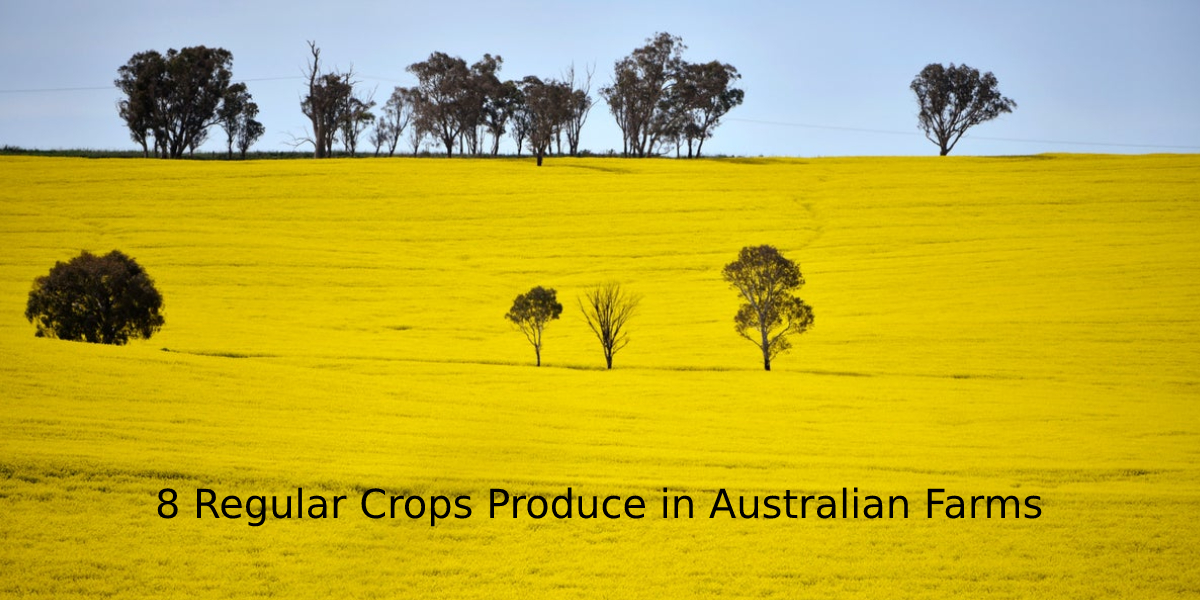
Although the most significant part of Australia is not suitable for crops and pasture, the nation has become one of the world’s leading agricultural producers and exporters. Australian products dominate both wool and grain markets across the globe. Agriculture accounts for about 3% of the GDP and employs roughly 4% of the total workforce, making it a great resource for the country’s economic growth. Although the segment’s contribution to Australia’s GDP is small, unprocessed and raw agricultural products contribute roughly 25% of the country’s total export earnings every year.
Here are eight regular crops grown in Australian farms.
1. Wheat
Wheat is one of the ancient, widely produced and renowned crops globally, thanks to foods such as bread and pasta. It’s also one of the most common cereal grains grown in Australian farms. Wheat used as stock feed and for domestic consumption is mainly produced in the eastern region, while the most exported wheat comes from western Australia.
2. Barley
Barley is a versatile crop produced in most Australian arable land except in the tropical areas of Queensland and Northern Territory. It’s the second-largest crop in volume. Australia produces nearly 7 million tons annually. Farmers mainly use broadacre farming techniques to grow barley, and the grain gets used predominantly in malting for the brewing sector or as animal feed. Barley is tolerant and can withstand saline soil conditions. It also withstands drier conditions than most crops.
3. Canola
Canola looks like a bed of yellow flowers. It’s Australia’s third-largest crop, grown for its seeds that get used in manufacturing fats and oils, like margarine. It can also get used as stock feed. Commonly known as the cleaning crop for its deep roots that help eliminate weeds, canola is usually produced in rotation with other crops.
4. Oats
Oats are well-adapted to grow in an array of environments and can withstand cooler conditions. They also tolerate poor soil conditions, which other cereal crops cannot. Oats are predominantly used to make hay, most of which gets exported. They’re also great for making silage, a crop that gets harvested when it’s still green and used as fodder for livestock.
5. Lucerne
Lucerne is a legume that’s predominantly used for making high-quality silage, hay, and stock feed. It’s produced throughout arable land in the country, especially Southern Australia. You can easily recognize it due to its short stature, leafy foliage, and blue, purple, or white flowers. Lucerne has deep roots, making it suitable for drier conditions. There are over 50 varieties of Lucerne in Australia, and the crop is a great stock feed. The crop gets planted in rotation to help improve soil fertility.
6. Sorghum
Sorghum is commonly grown in subtropical and tropical areas of Australia. It is widely used as stock feed, although it can get used as a biofuel plant. It’s easily recognizable due to its tall stature and a big head with either white, maroon, or yellow flowers. During its early stages of growth, sorghum can be lethal for livestock, including cattle.
7. Vetch
Commonly produced in the Southern Australia region, vetch is ideal for making fodder for livestock, including silage and hay. It can also get used as a grain. It’s planted in rotation with other crops to help add nitrogen to the soil and clear weeds and diseases.
8. Lentil
Easily recognizable for their short stature and broad leaves, lentil is grown in rotation with other crops as it helps fight diseases and improve soil fertility by adding nitrogen. Australian farmers usually grow green and red lentils. Although lentils have a higher value than other broadacre crops, they need more moisture than wheat and barley to thrive. Since Australia is a global market leader in many significant crops, understanding the most commonly produced crops can help farmers grow the most marketable crops. The above-listed crops are the reason why Australia is one of the world’s leading agricultural produce exporters.
