 Blogging Heros

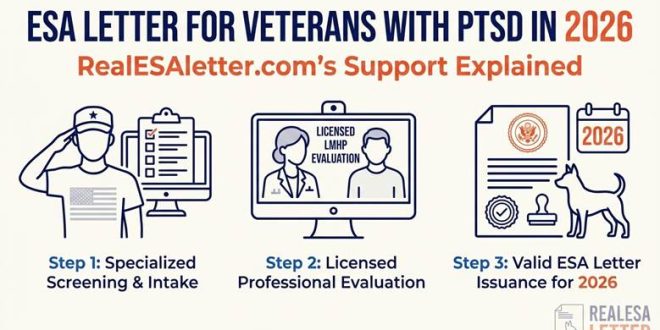
Veterans returning from service carry more than memories. For many, the invisible weight of post-traumatic stress disorder shapes every part of daily life, from disrupted sleep and hypervigilance to social withdrawal and chronic anxiety. In 2026, more veterans than ever are exploring emotional support animals as part of their mental health care, and knowing how to get an online ESA letter for veteran housing accommodation through a licensed provider is the critical first step.
An ESA letter is a formal document signed by a licensed mental health professional confirming that a veteran has a qualifying condition and that an emotional support animal is part of their treatment plan. Under the Fair Housing Act, this letter grants veterans the legal right to live with their ESA in no-pet housing, without paying pet deposits or facing breed restrictions.
This guide covers everything veterans need to know in 2026, from qualifying conditions and documentation requirements to housing rights and where to get a legitimate letter.
Why Veterans with PTSD Are Turning to ESAs in 2026
Post-traumatic stress disorder remains one of the most common and debilitating mental health conditions affecting U.S. veterans. According to the U.S. Department of Veterans Affairs, approximately 11 to 20 percent of veterans who served in Iraq and Afghanistan operations experience PTSD in any given year. For many, traditional therapy and medication alone do not address the full scope of daily emotional difficulty.
Emotional support animals offer something different. They provide consistent, non-judgmental companionship that can reduce the frequency of anxiety episodes, ease hyperarousal symptoms, and interrupt the cycle of isolation that PTSD often creates. A dog that senses distress and responds with physical presence, or a cat whose routine demands gentle interaction, can anchor a veteran to the present moment in ways that supplement clinical treatment meaningfully.
In 2026, the broader recognition of emotional support animals for veterans has grown significantly, with more housing providers and mental health professionals acknowledging ESAs as a legitimate part of care plans. This shift makes obtaining proper documentation more important than ever, both for protecting housing rights and for ensuring the ESA relationship is legally recognized.
Some of the most common reasons veterans seek ESA letters in 2026 include:
- Managing combat-related PTSD symptoms including nightmares and hypervigilance
- Reducing social isolation after transitioning from military to civilian life
- Supplementing existing VA mental health treatment plans
- Securing no-pet housing without paying additional pet fees or deposits
- Establishing a structured daily routine through animal care responsibilities
What a Legitimate ESA Letter for Veterans Actually Requires
Not every document labeled an “ESA letter” carries legal weight. Veterans need to understand what separates a valid ESA letter from a fraudulent one, because submitting an illegitimate letter to a landlord can result in denial, legal complications, and loss of housing protections.
A legitimate ESA letter for veterans must include all of the following:
- Professional letterhead with the therapist’s name and contact information
- The therapist’s active license number and state of licensure
- The veteran’s full name and date of birth
- Confirmation that the veteran has a qualifying mental health condition under the DSM-5
- A statement that an emotional support animal is a necessary part of the treatment plan
- Date of issuance and the therapist’s signature
What a legitimate letter does not include is a specific diagnosis. Under HIPAA, the therapist confirms the existence of a qualifying condition without disclosing the exact diagnosis to the landlord. Veterans sometimes worry that getting an ESA letter means sharing sensitive military mental health history. It does not. The letter is a clinical recommendation, not a medical disclosure.
Veterans should also know that letters obtained from websites offering instant approval with no consultation, no licensed therapist review, and no clinical assessment are not valid. These are scam products that will not hold up under landlord or housing authority scrutiny. For guidance on what qualifies someone for an emotional support animal and what documentation anxiety, depression, and PTSD sufferers need, the emotional support animal for anxiety resource from RealESAletter.com walks through the clinical standards in plain language.
How Veterans Qualify for an ESA Letter: The LMHP Assessment Process
Qualifying for an ESA letter does not require a veteran to have a formal VA disability rating, though many veterans who apply do have documented service-connected conditions. The qualifying standard is based on the DSM-5, the Diagnostic and Statistical Manual of Mental Disorders, which defines the range of conditions that can support an ESA recommendation.
Veterans commonly qualify under conditions including:
- Post-traumatic stress disorder (PTSD)
- Major depressive disorder
- Generalized anxiety disorder
- Adjustment disorder related to military-to-civilian transition
- Insomnia and sleep disorders linked to combat experience
- Social anxiety disorder
The assessment process through a licensed mental health professional typically involves completing a clinical questionnaire about symptoms, daily functioning, and how an emotional support animal would support the veteran’s treatment. In most states, this process can be completed entirely online through a telehealth consultation with a state-licensed LMHP.
Veterans pursuing a military emotional support animal letter should be aware of state-specific requirements. A small number of states, including California, require a 30-day client-provider relationship before an ESA letter can be issued. In most other states, a single telehealth consultation is sufficient once the therapist has reviewed the veteran’s responses and determined eligibility.
The LMHP does not need to be a VA provider. Any state-licensed mental health professional, including a licensed clinical social worker (LCSW), licensed professional counselor (LPC), or licensed marriage and family therapist (LMFT), has the authority to write a valid ESA letter for a veteran.
ESA Housing Rights Veterans Need to Know in 2026
Once a veteran holds a valid ESA letter, the Fair Housing Act provides clear and enforceable protections. These rights apply to the vast majority of rental housing across the United States, including apartments, condominiums, townhomes, and most university and transitional housing.
Key housing rights for veterans with an ESA letter in 2026:
- Landlords cannot charge pet deposits or pet fees for an ESA
- Landlords cannot enforce breed restrictions or size limits against an ESA
- Housing providers must respond to a reasonable accommodation request within a reasonable timeframe
- Landlords can request documentation (the ESA letter) but cannot demand access to medical records or a specific diagnosis
- Veterans affairs emotional support animal letters carry the same legal weight as those issued to any other qualifying tenant under the FHA
There are limited exceptions. Housing with four or fewer units where the landlord lives on-site is generally exempt from Fair Housing Act ESA provisions. Single-family homes sold or rented without a real estate broker are also typically exempt.
Veterans relocating to states with active rental markets in 2026 should check local housing rules in addition to federal protections. For Colorado veterans specifically, the ESA letter Colorado page on RealESAletter.com explains how Colorado Fair Housing Laws interact with federal FHA protections, and how Colorado-licensed therapists can issue a compliant letter for Denver, Colorado Springs, and surrounding areas.
Always verify your state’s specific ESA regulations and consult your housing provider’s policies before submitting documentation.
How RealESAletter.com Supports Veteran ESA Documentation
RealESAletter.com has issued more than 20,000 ESA letters to pet owners across all 50 states, and in 2026 their service remains one of the more straightforward options available to veterans seeking a legitimate, housing-compliant letter without navigating long wait times or confusing paperwork.
The process works in a few steps:
- Complete a free online qualification questionnaire
- Get matched with a state-licensed LMHP who reviews the responses
- Attend a brief telehealth consultation if required by the veteran’s state
- Receive the ESA letter by email within 24 hours of approval, with a physical copy mailed separately
RealESAletter.com’s network includes licensed clinical social workers, licensed professional counselors, and licensed marriage and family therapists credentialed in all 50 states. Their letters are written on official professional letterhead and include all elements required by HUD and the Fair Housing Act.
Veterans who do not receive an approved letter are covered by a 100% money-back guarantee. The service is also HIPAA-compliant, meaning a veteran’s mental health information is handled with the same privacy protections that apply to any clinical consultation.
For veterans navigating housing applications throughout 2026, having a properly documented ESA letter from RealESAletter.com means approaching landlords with paperwork that is recognized, legally compliant, and issued by a credentialed professional rather than an online form generator.
Frequently Asked Questions
Can a veteran with PTSD qualify for an ESA letter through an online service in 2026?
Yes. Veterans with PTSD can qualify for an ESA letter through a legitimate online telehealth service in 2026. The qualifying process involves a clinical assessment by a state-licensed LMHP who determines whether the veteran’s condition meets DSM-5 criteria for an emotional support animal recommendation. RealESAletter.com’s licensed therapist network handles this process entirely online in most states.
Does the VA provide an emotional support animal letter for veterans?
The VA does not formally issue ESA letters as part of standard veteran care. VA mental health providers can, in some cases, write letters for veterans they are treating, but the VA does not have a standardized ESA letter program. Veterans who cannot obtain a letter through VA care typically use a licensed private LMHP or a telehealth service like RealESAletter.com to get a compliant letter for housing purposes.
What mental health conditions in veterans qualify for an ESA letter under the Fair Housing Act?
Veterans commonly qualify with PTSD, major depressive disorder, generalized anxiety disorder, adjustment disorder, insomnia, and social anxiety. The condition must be recognized under the DSM-5 and must functionally limit one or more major life activities. A licensed mental health professional makes this determination during the clinical assessment.
Is a military emotional support animal letter different from a civilian ESA letter?
No. There is no legally separate category called a military ESA letter. A valid ESA letter for a veteran follows the same requirements as any FHA-compliant ESA letter. It must be signed by a state-licensed LMHP, include all required elements, and confirm a qualifying DSM-5 condition. The veteran’s military background informs the clinical picture but does not change the legal structure of the document.
How long does it take a veteran to receive an ESA letter from RealESAletter.com?
Most veterans receive their ESA letter within 24 hours of completing the consultation and approval process. States requiring a 30-day therapist-client relationship, such as California, may take longer. RealESAletter.com delivers letters digitally by email, with a physical copy mailed separately, so veterans can submit documentation to landlords quickly during housing searches in 2026.
Conclusion
Veterans with PTSD deserve access to mental health support tools that work alongside their existing care. An ESA letter is not a workaround or a convenience document. It is a legitimate clinical recommendation that carries legal force under the Fair Housing Act, protecting a veteran’s right to live with an animal that supports their recovery. In 2026, the process for obtaining that documentation has never been more accessible. RealESAletter.com connects veterans across all 50 states with licensed mental health professionals who understand the documentation standards landlords require and the real mental health needs veterans carry.


