

Table of Contents
In recent times, the demand for healthcare software systems has clearly increased; in fact, some of the systems, like those of Electronic Health Records, have become the epicenter for practice management and even care delivery.
When I talk about the demand for these software systems, I specifically talk about the rise of customized solutions, and EMR development is leading the way right from the front with the highest adoption rate.
However, as the demand for custom EHR development rises, there is also a rise in system failures. While interacting with some of the esteemed providers in the industry, I realized that the problem lies in the technology stack that they have chosen.
And that is the reason that you’ve come to this article, right? You see, your EHR is only as strong as its technology stack, and let’s be honest, many providers and administrators don’t know how to evaluate tech stack proposals properly. That is why some of the custom solutions are slow, with poor usability and limited scalability, or even worse, HIPAA risks.
In simple words, they are just developing a replica of off-the-shelf solutions. So, what can be done?
Well, choosing the right foundation during the development process is crucially important. With the right EHR technology stack, you can almost cover all the aspects of the EHR that you actually want to build.
But here, the question comes, how to choose the right technology stack, right?
Well, let this blog be your guide to choosing the right technology stack for your custom EHR development.
What Every EHR Tech Stack Must Deliver: Security, Compliance & Scalability
There are some aspects that your EHR technology stack must deliver; if the tech stack is not able to support these aspects, then it’ll probably impact the day-to-day functioning of your system. And these aspects are security, compliance, and scalability. Some of the aspects that you need to consider in this are:
HIPAA & HITECH Requirements: Your tech stack must meet the requirements of HIPAA and the HITECH Act. Some of the features and functionalities in this include encryption, audit log capabilities, access control, etc., which must be hardcoded into the architecture.
Data Integrity: EHR databases must support accuracy, traceability, and tamper-proof data handling. Since the data you deal with is crucial and integrated, ensuring its integrity is extremely important.
High Scalability: With time, your practice is bound to grow, and your EHR system must be able to handle growing volumes, multi-location expansion, and even integration needs.
Cloud-Native Advantage: Since the whole purpose is to improve access, you must have a cloud-native architecture. You can use cloud-native platforms like AWS, Azure, GCP, etc., which offer auto-scaling, backups, disaster recovery, and HIPAA-compliant EHR or HIPAA-ready infrastructure.
Performance Optimization: One of the most important aspects that your EHR tech stack must support is its ability to optimize performance. Aspects such as fast loading, low latency, and stable uptime are necessary for your clinical and administrative activities, and your tech stack must be able to deliver that.
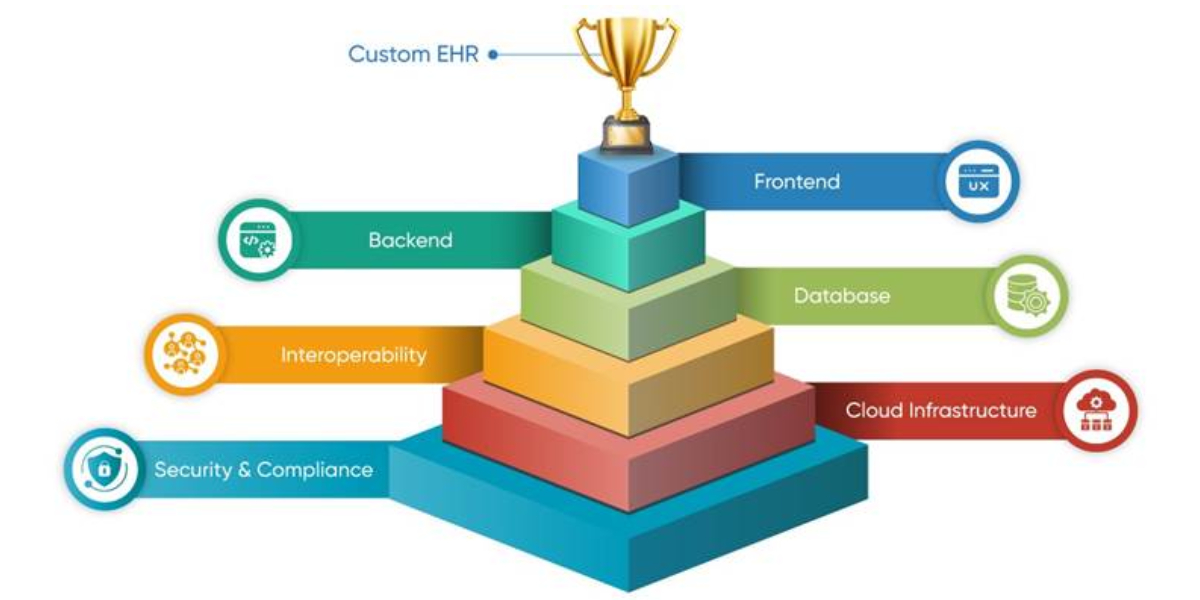
The Core Tech Stack Explained
For our non-technical readers, I have made an effort to explain the core tech stack in as simple terms as possible. So, deep dive to know the simplified version of your EHR technology stack.
Frontend Layer: This is basically what your staff or anybody who is using the software sees. This part of the software should be intuitive, fast, and easily accessible. Some of the common frameworks used in this are React, offering speed and scalability, or Angular, which provides a strong structure, or Vue.js, which is lightweight and easy to understand. Some of the things that you should focus on while developing this are to reduce clicks and enable faster charting.
Backend Layer: Behind the screen, in the wires, is where the logic is applied that runs your EHR. This is where the system handles scheduling, orders, billing, documentation, and even audit trails. Here, you must focus on supporting concurrency, real-time data management, and using secure API workflows. Some of the reliable choices that we use for backend are Python/Django, Java Spring Boot, and .Net Core.
Database Layer: Since everything you do in your EHR system will be done in data, the data needs to be stored somewhere, right? This is where this comes into the picture. You can use relational databases for clinical accuracy, such as PostgreSQL, MySQL, and MS SQL. Some of the features you need to overlook in this are encryption, ACID compliance, audit trails, and FHIR-ready models.
Interoperability Layers: For allowing your system to communicate with other systems, you need to adhere to healthcare interoperability standards. By adhering to these standards, connecting to labs, pharmacies, payers, billing, imaging, and telehealth systems becomes much easier. Some of these standards you need to adhere to are FHIR, HL7 v2, DICOM, and CCDA. These standards form the backbone of your EHR system, making it seamless for data transfer and allowing you to deliver unified care.
The Power of Open Source Tools in EHR Development
I agree that getting some of the licenses can be expensive and can dismantle your budget almost instantly. But as they say where there is will, there is a way, with the use of open source tools in EHR development, you can almost get these things for free with the use of open source tools. Here are some of the advantages of using open source tools:
Cost Saving: With open source tools, you don’t require expensive enterprise licenses. They can be extremely crucial for cost saving and help you save thousands of dollars in development.
Security: Large communities constantly test and patch the vulnerabilities in their system, and since open source tools have a large community, they are constantly tested and secured for your use.
Customization: One of the most important uses of open source tools is that they allow for rapid adaptation and customization as per your needs. This can be crucial for healthcare practices that offer services like urgent care, behavioral health, pediatrics, etc.
Vendor Independence: Open source tools can be used by anyone; this way, you can avoid being locked into the set technology stack that you initially used for development.
Some of the prominent examples for this are Linux servers, PostgreSQL databases, React frontends, and Python backends.
What to Look for In An EHR Development Partner
Choosing the right development partner is something that can be tricky, especially when it comes to choosing the right technology stack. They usually give you the stack in which they are good. To help you with that process, here are some things that you should consider:
Healthcare Expertise: Check for their expertise in developing healthcare software systems. Furthermore, they must be familiar with developing HIPAA-compliant EHR systems and be able to comply with necessary requirements like HIPAA, FHIR, CMS Rules, and ONC.
Clear Technical Justification: Ask your vendor the right question and expect that they should be able to explain to you why they are using that particular technology. While assessing their answers, look at whether their choices fit your specific goals or not.
Workflow Mapping: Development must reflect your clinical workflows; you are customizing the software, so ask them to develop them and not use any generic templates.
Future-Ready Design: Keeping the trends in mind, look if the vendor is building a scalable healthcare software or not. And the best way to assess that is by looking for that in their design. Their design should support telehealth, AI, analytics, and expansion.
Long-Term Support: The real work starts after the implementation of the software. That is why you should check if the vendor provides long-term support or not. When dealing with real data, your software will require continuous security patches and enhancements to keep the system running.
Conclusion
The success of a custom EHR depends heavily on the technology stack chosen at the foundation level. As outlined in this blog, tech stack decisions directly impact system performance, security, compliance, usability, and long-term scalability. A well-designed architecture ensures your EHR can support growing patient volumes, evolving workflows, interoperability requirements, and future innovations like telehealth and analytics.
By selecting cloud-native, secure, and healthcare-compliant technologies—and partnering with an experienced EHR development team—you avoid replicating the limitations of generic systems. Simply put, smart EHR development begins with smart technology decisions that keep your system adaptable, reliable, and ready for growth.
So, what are you waiting for? Click here to book your first free consultation.
FAQs
What technologies are best for building a custom EHR?
The best technologies for custom EHR development are those that balance performance, security, scalability, and interoperability. Most modern EHR platforms use robust backend frameworks (such as Java, .NET, or Node.js), scalable databases (PostgreSQL, MySQL, or MongoDB), and secure frontend frameworks (React or Angular) for intuitive clinician experiences. Crucially, the EHR technology stack must support healthcare interoperability standards like FHIR/HL7 APIs, enabling seamless data exchange with external systems. Choosing modular, API-first technologies ensures your EHR can evolve as clinical and regulatory needs change.
How do I ensure an EHR tech stack is HIPAA-compliant?
A HIPAA-compliant EHR starts with security-by-design. The technology stack should include end-to-end encryption, role-based access control, audit logs, secure authentication, and automated backups. Compliance is also influenced by infrastructure choices—HIPAA-aligned cloud platforms, secure DevOps practices, and regular security audits are essential. Importantly, HIPAA compliance is not just about tools, but how they are configured, monitored, and maintained throughout the EHR lifecycle.
Can a custom EHR integrate easily with labs, billing, and imaging systems?
Yes—when built on modern healthcare interoperability standards, a custom EHR integrates far more easily than legacy systems. Support for FHIR/HL7 APIs allows seamless connections with labs, pharmacies, billing platforms, imaging systems (PACS), and health information exchanges (HIEs). A well-designed, API-driven EHR architecture ensures integrations remain flexible, scalable, and future-proof without disrupting core clinical workflows.
Should an EHR be hosted on cloud infrastructure or on-premises?
Most healthcare organizations today prefer cloud-based EHR systems due to their scalability, faster deployments, built-in security controls, and lower infrastructure overhead. Cloud environments also support disaster recovery and multi-location access more efficiently. On-premises hosting may still suit organizations with strict data residency or legacy constraints, but it often limits agility. For long-term growth and scalable healthcare software, cloud-first EHR architectures are typically the smarter choice.
