


Table of Contents
Have you ever opened an app update, glanced at the release notes, and thought, “Do I really need to read this?”
You scroll, skim, and move on…without truly knowing what changed.
Does this sound like something you’re dealing with?
Now picture this: you open an update, and it tells you right away what’s new, why it matters, and how it makes your job easier.
You don’t just read it—you explore it. You actually use the feature.
So what changed: the product or the way it was presented?
That’s what release notes are for Release notes have changed over time, from long, technical changelogs meant only for developers to smart, in-app messages meant for users.
In this blog, we’ll look at that journey and see how release notes went from being simple updates to powerful product experiences.
Early days: Static, technical changelogs meant for developers
Release notes were initially simple and highly technical, referred to as changelogs, and written primarily for developers. They worked on fixing bugs, making technical improvements, and updating the code.
These release notes were frequently lengthy, text-heavy, and difficult for non-technical users to understand. They were often put on documentation pages.
Release notes were more about keeping track of changes than making things clear and easy to understand for regular users.
But as users’ needs grew, release notes had to change from just keeping track of changes to also explaining their value.
Shift: Moving to user-friendly, benefit-driven release notes
Companies found out that users don’t just want to know what changed, they also want to know how it helps them. People began to expect simple answers, clear benefits, and real-world effects as products became more user-focused.
Technical terms were replaced with language that was easy to understand. Over time, release notes got clearer, more interesting, and more useful. They went from being simple updates to being useful ways for users to talk to each other.
However, making release notes user-friendly was not enough, the next challenge was visibility.
Multi-channel era: Blogs, emails, and social distribution expand reach
As products fought for attention, being seen became just as important as the update itself.
- Blogs provided detailed updates to help users understand features and changes more clearly.
- Emails directly informed users of updates, ensuring that critical information was delivered quickly.
- Social media generated excitement and raised awareness about new features and releases.
This multi-channel strategy helped reach a larger audience and made release notes an important part of product communication.
Modern approach: In-app announcements for contextual communication
Today, the biggest transformation in release notes is happening inside the product itself. Instead of making users look for updates, products now send them to users where they are already—inside the app.
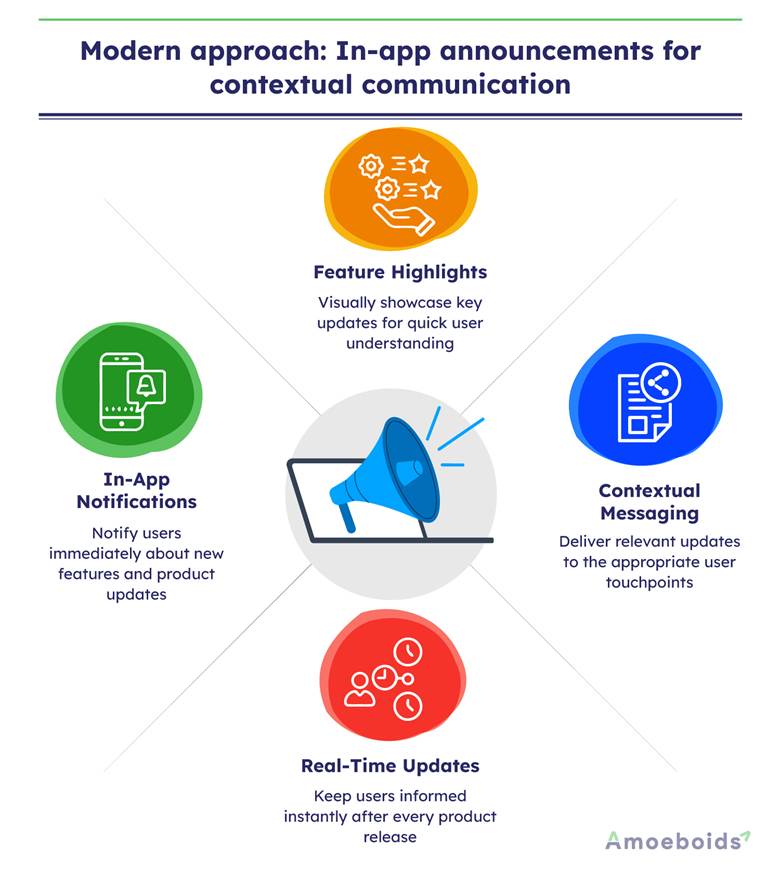
- In-App Notifications: Users get instant notifications about new features or updates. This makes sure they don’t miss any important changes.
- Feature Highlights: Key updates are visually displayed, allowing users to quickly understand what’s new.
- Contextual Messaging: Updates go exactly where they need to go, which makes sure that users see them at the right time and improves the whole experience.
- Real-time updates: Users are always up to date because real-time updates let them know right away after releases. They make things easier to see, understand, and act on, making workflows more efficient.
Transformation: From information to interactive product experiences
Release notes are no longer just for sharing information. They are now a part of the whole product experience.
- User-Centric Updates: Now, release notes are written with users in mind, focusing on how changes help in real life. This makes updates more useful and important.
- Interactive Communication: Release notes now include more than just text. They also have images, walkthroughs, and links that you can click on. This makes updates more interesting and helps people find out about new features.
- Feature Discovery: Updates are meant to make it easier for users to find and use new features. This makes people want to try them out and see how useful they are in the product.
- Product Engagement: People are more likely to use a product if the release notes are short. Instead of just telling users about new updates, they help them use and experience them.
Release notes start to have a real business effect when they are part of the product experience instead of just telling users what to do.
Business impact: Driving adoption, engagement, and retention
Better release notes help a product grow by making it easier for users to understand, get involved, and see its long-term value.
- Feature Adoption: People are more likely to try a feature if they know exactly what it does and how it helps. Simple release notes that focus on the benefits help users understand what’s new and get them to try it out.
- User Engagement: Release notes that are appealing keep users interested in what’s new and worth trying. If updates are easy to read and useful, people are more likely to use a product and stay active over time.
- Customer Retention: People are more satisfied with a product when they see regular improvements and clear updates. This makes them trust you more and want to keep using it instead of switching to something else.
- Product Awareness: Release notes keep users up to date on all the new features and improvements. Users can get more out of a product when they know what it can do.
Conclusion
Release notes have changed from simple, technical changelogs to strong ways to communicate. What used to help developers now has a big impact on how users interact with the software.
From clear language to multi-channel distribution and in-app announcements, each stage has brought release notes closer to users. They now provide users with real-time guidance, engagement, and support.
The main point is simple: don’t forget about release notes. They drive adoption and engagement when done right.
Use the Automated release notes and reports app for Jira to easily deliver consistent, clear, and impactful updates.
