Blogging Heros
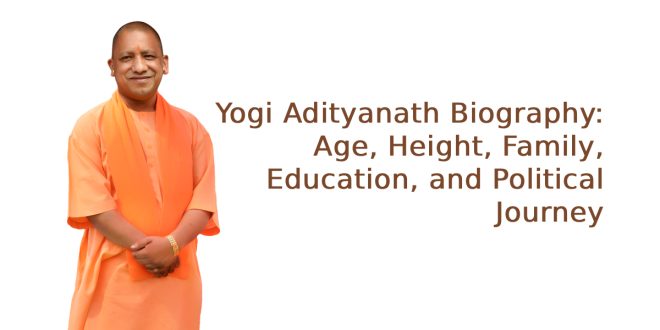
Mahant Yogi Adityanath is one of the most prominent political figures in contemporary Indian politics — known for his unique journey from a young monk to the Chief Minister of Uttar Pradesh, India’s most populous state. His life reflects a blend of spiritual discipline, strong political will, and grassroots activism. This detailed and engaging biography explores every major aspect of his life, including age, height, family background, educational qualifications, early influences, spiritual transformation, and political journey.
Early Life and Background
Yogi Adityanath was born on 5 June 1972 in the small village of Panchur in the Pauri Garhwal district of Uttarakhand, India — then part of Uttar Pradesh. His birth name was Ajay Singh Bisht (sometimes also referenced as Ajay Mohan Singh Bisht).
He was born into a Garhwali Hindu Rajput family, where his father, Anand Singh Bisht, worked as a forest ranger, and his mother, Savitri Devi, looked after the home. Growing up in a rural setting shaped his early years, instilling in him the values of simplicity, respect for tradition, and service to society.
As a child, Yogi’s qualities of leadership and discipline were evident. He was active in sports like badminton and swimming, showing both physical and mental rigor alongside academics.
Early Life Snapshot
| Attribute | Detail |
|---|---|
| Full Name | Ajay Singh Bisht |
| Birth Date | 5 June 1972 |
| Birthplace | Panchur, Pauri Garhwal, Uttarakhand, India |
| Family Background | Garhwali Hindu Rajput family |
| Father | Anand Singh Bisht (Forest Ranger; deceased 2020) |
| Mother | Savitri Devi (Housewife) |
| Siblings | Several siblings, including brother Mahendra Singh Bisht |
| Early Interests | Sports (badminton, swimming), community service |
Physical Appearance & Personal Traits
Yogi Adityanath is known for his stoic presence and disciplined lifestyle — traits that are often associated with his spiritual and political outlook.
Physical Attributes
| Attribute | Detail |
|---|---|
| Height | ~5 ft. 4 in (163 cm) |
| Eye Colour | Black |
| Hair Colour | Black |
| Marital Status | Unmarried |
| Lifestyle | Monk, follows strict discipline and celibacy |
His choice to remain unmarried and celibate reflects his commitment to spiritual life, and fits with the image he has cultivated as a monk-politician.
Education and Spiritual Calling
Education played an important role in shaping Adityanath’s analytical mind and leadership skills. He completed his schooling in local schools around Pauri and Rishikesh.
He went on to pursue his higher education at the Hemwati Nandan Bahuguna Garhwal University in Uttarakhand, where he earned a Bachelor of Science (B.Sc.) degree in Mathematics. This academic background — particularly in a subject like mathematics — contributed to developing his logical and analytical thinking.
While studying, he also became involved with student organizations like the Akhil Bharatiya Vidyarthi Parishad (ABVP), where he first explored leadership and social involvement.
After completing his education, Adityanath’s path took a profound spiritual turn. Around the age of 22, he entered the Gorakhnath Math in Gorakhpur, a historic Hindu monastery with deep roots in Indian culture and spirituality. This marked the beginning of his spiritual career under the tutelage of Mahant Avaidyanath, a revered monk and political figure.
Subsequently, he received his Diksha (initiation) into sanyas (monastic life), adopting the name ‘Yogi Adityanath’, and later succeeded Avaidyanath as the Mahant (chief priest) of Gorakhnath Math in 1994.
Education & Spiritual Milestones
| Phase | Key Detail |
|---|---|
| Primary Education | Local schools in Pauri & Rishikesh |
| Higher Education | B.Sc. in Mathematics |
| University | Hemwati Nandan Bahuguna Garhwal University |
| Spiritual Initiation | Joined Gorakhnath Math; received Diksha |
| Became Mahant | 1994 (succeeded Mahant Avaidyanath) |
Early Political Involvement
Although his life began in academia and spirituality, Yogi Adityanath’s trajectory soon moved towards active politics. His association with the Hindu nationalist movement and Mahant Avaidyanath gave him a platform to connect spiritual leadership with public engagement.
In 1996, he got an opportunity to manage Avaidyanath’s Lok Sabha election campaign, signaling his entry into practical politics. Realizing his potential as a grassroots leader, the Bharatiya Janata Party (BJP) fielded him as its candidate for the Gorakhpur Lok Sabha constituency in 1998.
At just 26 years of age, Yogi Adityanath was elected to the 12th Lok Sabha, making him one of the youngest Members of Parliament in India at the time.
Parliamentary Career (1998–2012)
After his first victory in 1998, Yogi Adityanath’s influence in the political world grew rapidly:
- 1999 & 2004 – Re-elected as MP from Gorakhpur constituency.
- Hindu Youth Involvement – In 2002, he formed the Hindu Yuva Vahini, a socio-political organisation aimed at mobilising youth and supporters of Hindu nationalism.
- Throughout his tenure in Parliament, he was known for vociferous debates on issues related to culture, security, and national identity.
This phase consolidated his reputation as a strong voice for conservative values and regional interests. It also established his leadership among the BJP’s cadre in Eastern Uttar Pradesh.
Rise to Chief Ministership (2017 onwards)
In 2017, the BJP won a historic majority in the Uttar Pradesh Legislative Assembly elections, and Yogi Adityanath was appointed Chief Minister of Uttar Pradesh.
He made headlines nationally and internationally for his administrative approach, prioritising law and order, infrastructure development, and religious tourism projects. Over time, his governance style — often termed as disciplined and firm — garnered both praise and criticism, cementing his place as a defining leader in state politics.
As Chief Minister, he held significant portfolios beyond just administrative functions, overseeing departments like Home, Revenue, Urban Development, and more, reflecting the trust the party leadership placed in him to steer the state’s trajectory.
In 2022, he was reaffirmed as Chief Minister following another decisive victory for the BJP in Uttar Pradesh. This marked his second consecutive term, and as of 2025, he has become one of the longest-serving Chief Ministers in the state’s history, surpassing earlier records.
Major Political Initiatives and State Governance
As Chief Minister, Yogi Adityanath’s governance has centered on several major initiatives:
a) Law & Order Reforms
His administration has focused heavily on reducing crime, improving policing, and ensuring stricter enforcement of law and order.
b) Infrastructure and Economic Development
Large-scale infrastructure projects including expressways, urban development, and connectivity initiatives have characterised his tenure.
c) Social Welfare Programs
The state under his leadership has expanded schemes for education, healthcare, women and child welfare, and disability support. For example, during World Disability Day functions, the government announced enhancements in pension, supportive devices, and accessibility services based on the Chief Minister’s vision.
d) Demographic Policy Dialogue
In 2025, he received policy proposals like the Area-wise Demographic Policy aimed at balancing education advancement and social cohesion — indicating the evolving focus on long-term societal frameworks.
Yogi Adityanath Family and Personal Life
Although he has been a public figure for decades, Yogi Adityanath has maintained a very private personal life.
Immediate Family Details
| Name | Relationship | Notes |
|---|---|---|
| Anand Singh Bisht | Father | Forest Ranger; passed away in 2020 |
| Savitri Devi | Mother | Homemaker |
| Mahendra Singh Bisht | Brother | Served in the Indian Army |
| Other Siblings | Brothers & Sisters | Involved in various professions |
He chose sanyas early in life and never married, dedicating his life to spiritual and public service. This choice reflects his deep commitment to spirituality and public engagement over personal familial roles.
Criticism, Controversy and Public Perception
Like any leader in the national spotlight, Yogi Adityanath has been a controversial figure at times. His politics, especially around religious identity and law enforcement, have drawn both:
- Support from proponents who see him as a decisive leader safeguarding cultural values.
- Criticism from opponents who argue that his policies sometimes fuel divisive politics or infringe on civil liberties.
These diverse perspectives reflect the broader debates in Indian society about identity politics, governance priorities, and the role of religion in public life.
Legacy and Impact
Whether praised or critiqued, Yogi Adityanath’s influence is undeniable. From humble beginnings in Uttarakhand’s hills to becoming the head of the government in India’s most politically significant state, his life journey is studied by scholars, politicians, and citizens alike.
He represents a distinct model of leadership in Indian politics where spirituality intersects with assertive public governance. His longevity in power and policymaking impact has shaped Uttar Pradesh’s economic, cultural, and political landscape into the 2020s.
Conclusion
Yogi Adityanath’s biography is not just a story of personal rise but also a reflection of modern India’s sociopolitical evolution. From Ajay Singh Bisht — a young student with a degree in mathematics — to Yogi Adityanath, the monk-politician and Chief Minister of Uttar Pradesh, his life embodies complexity, ambition, discipline, and influence.
His blend of spiritual roots and political power continues to generate discussion, inspiration, and debate — making him one of the defining leaders of contemporary Indian public life.
The only purpose of this post is to share the information about CM Yogi Adityanath Ji.
If anyone find any wrong data please contact us to share correct right data with valid source.