Blogging Heros
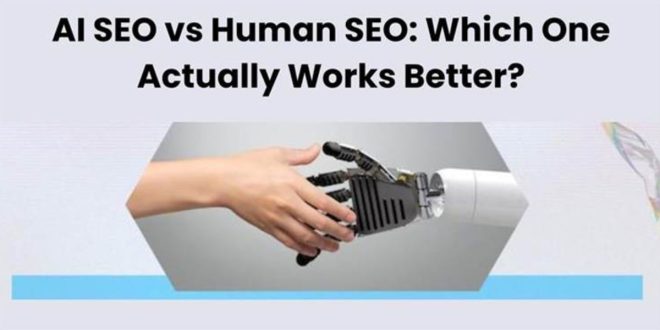
Neither AI SEO nor human SEO is better on its own. The most effective approach today is a combination of both, where AI handles speed and data-driven tasks while humans bring strategy, creativity, and trust into the process.
Search engine optimization has evolved far beyond simple keyword placement. What used to be a manual process is now supported by powerful tools, and increasingly, by artificial intelligence. At the same time, search engines are getting better at evaluating content quality, intent, and credibility. This creates a new challenge. It is no longer about choosing between AI and humans, but about understanding how each contributes to better results.
This article breaks down both approaches in detail, compares their strengths, and explains where each fits in modern SEO.
Understanding AI SEO in Practical Terms
AI SEO refers to using artificial intelligence tools to automate and improve different parts of the SEO workflow. These tools are designed to process large amounts of data quickly and generate insights or content from it.
Common applications of AI in SEO include:
- Keyword research and clustering
- Content generation and outlining
- Competitor analysis
- On-page optimization suggestions
- Technical SEO audits
The biggest advantage of AI SEO tools is efficiency. Tasks that once took hours can now be completed in minutes. Therefore, large-scale content production and optimization can be achieved without hiring more resources.
Pros of AI SEO Tools:
- Efficiency in Research: AI can cluster thousands of keywords into topical pillars in seconds, a task that would take a human days of spreadsheet work.
- Predictive Analytics: Tools now use historical SERP data to predict ranking volatility, allowing you to optimize before an algorithm update hits.
- Technical Monitoring at Scale: AI-driven crawlers can monitor enterprise-level sites (100k+ pages) in real-time, flagging broken schema or internal linking gaps immediately.
- AEO and GEO Optimization: New tools are specifically designed to optimize for “Answer Engine Optimization” (AEO) and “Generative Engine Optimization” (GEO), helping content get cited in AI-generated overviews.
Cons of AI SEO Tools:
- Lack of Strategic Context: An AI tool cannot understand your business’s profit margins. It might suggest ranking for a high-volume term that brings no actual revenue.
- The “Homogenization” Trap: AI models are trained on existing data. If you rely solely on AI for content, you are essentially publishing a “median” version of what already exists, which fails Google’s “Information Gain” criteria.
- Hallucinations: AI tools can misinterpret technical data or fabricate facts, leading to misinformation that can trigger manual penalties.
What Human SEO Expert Still Does Better
Human SEO experts focus on strategy, interpretation, and creativity. They understand not just what people search for, but why they search and how to meet those expectations through content.
A human SEO expert is good at:
- Building a long-term SEO strategy
- Understanding complex search intent
- Creating engaging and original content
- Aligning content with brand voice
- Making judgment-based decisions
Human expertise becomes especially important in competitive niches where differentiation matters. While AI can generate content, it often mirrors what already exists. Humans, on the other hand, can introduce new perspectives and deeper insights.
Pros of Human SEO Expertise:
- First-Hand Experience: A human can provide original insights, case studies, and “lived experience” that an AI cannot replicate. This is currently the strongest ranking signal.
- Nuanced Decision Making: SEO often involves trade-offs. For example, a human expert knows when to ignore a “low SEO score” from a tool to maintain a brand’s unique voice or user experience.
- Relationship Building: High-tier link building and digital PR still rely entirely on human relationships. AI cannot pitch a journalist or negotiate a partnership effectively.
- Algorithm Interpretation: When traffic drops, a human expert can distinguish between a technical glitch, a competitor’s move, or a core algorithm shift.
Cons of Human SEO Expertise:
- Limited Scalability: A human cannot manually audit 10,000 meta descriptions or analyze the semantic density of 50 competitors in an afternoon.
- Higher Costs: Professional expertise is an investment. Relying purely on manual processes in 2026 is often too slow and expensive for most businesses.
AI vs Human SEO: A Real Comparison
To understand how these approaches differ, a fair comparison is necessary across:
Speed and efficiency:
- AI delivers results quickly and handles repetitive tasks with ease.
- Humans take more time but produce more refined outputs.
Content quality:
- AI creates structured, optimized content but may lack uniqueness.
- Humans produce more engaging and original content.
Scalability:
- AI allows large-scale content production.
- Humans are limited by time and resources.
Context and accuracy:
- AI relies on existing data and may miss nuance.
- Humans interpret context and intent more effectively.
Cost and return:
- AI reduces upfront costs.
- Humans often deliver stronger long-term value.
This comparison shows that both AI and Human SEO address different parts of the problem.
Where to Use AI in SEO
AI in SEO is most effective when speed and scale are required. It is particularly useful for tasks that involve processing large amounts of information or generating structured outputs.
Best use cases for AI SEO:
- Creating first drafts of content
- Generating multiple topic ideas
- Clustering keywords at scale
- Optimizing existing content
- Running technical audits
Using AI in these areas allows teams to focus their time on more strategic work.
Where Human SEO Remains Essential
Tasks that require creativity, judgment, or relationship building still need a real expert, not an AI bot.
Best use cases for human SEO:
- Developing content strategy
- Writing high-conversion pages
- Producing thought leadership content
- Building backlinks through outreach
- Managing brand voice and positioning
In these situations, human input directly affects the outcome’s effectiveness.
How AEO and GEO Are Reinforcing the Role of AI
Search behavior is changing. Users are increasingly getting direct answers instead of clicking through multiple links. This shift is driven by Answer Engine Optimization and Generative Engine Optimization.
While AEO focuses on providing clear, direct answers, GEO focuses on creating content suitable for AI-generated responses.
This shift favors AI-powered SEO in several ways:
- AI can structure content into clear question-and-answer formats.
- It produces concise and well-organized information.
- It aligns with how search engines extract and display answers.
At the same time, human input remains critical.
Reasons human SEO still matters in AEO and GEO:
- Search engines prioritize trustworthy and authoritative sources.
- Original insights increase the chances of being referenced.
- Brand credibility cannot be automated.
AI helps format and scale content for these systems, but humans ensure that the content is worth using.
The Hybrid SEO Approach That Actually Works
The most effective SEO strategy today combines AI efficiency with human expertise. This hybrid approach allows businesses to scale while maintaining quality.
A practical workflow looks like this:
- AI handles research and generates initial drafts.
- Humans review, edit, and refine the content.
- AI tools assist with optimization and analysis.
- Humans make final strategic decisions.
Benefits of the hybrid approach:
- Faster content production without sacrificing quality.
- Better alignment with user intent.
- Improved consistency and scalability.
- Stronger long-term results.
Using both helps modern SEO teams operate successfully.
How Search Engines Evaluate AI and Human Content
Search engines focus on the usefulness of content rather than how it is created. Content that provides value, answers questions clearly, and demonstrates credibility is more likely to rank well.
Important factors that influence rankings:
- Relevance to search intent
- Depth and accuracy of information
- User experience and readability
- Signals of trust and authority
Low-quality content, whether created by AI or humans, will struggle to perform. This makes quality control essential regardless of the method used.
Final Verdict: Which One Is Better?
What works best in 2026 is Human-Led AI SEO. Relying solely on tools leads to generic, “thin” content that will eventually be filtered out by search generative experiences. Relying solely on human effort leaves you behind competitors who use automation to move 10 times faster.
The best approach is to consult SEO experts who use AI to handle the data, freeing you to focus on what search engines actually want: originality, authority, and real-world value.
FAQs
Can AI-generated content rank on the first page?
Yes, but raw AI content often ranks well initially but fails to maintain that position because it lacks “Information Gain.” To rank long-term, AI content must be edited by a human to include unique data, expert quotes, or personal experience.
Will AI tools eventually replace SEO experts?
No. They are replacing SEO technicians. The role of the SEO expert is shifting from “person who does the work” to “person who directs the AI and makes strategic decisions.”
Is it better to invest in an AI SEO tool or hire an SEO consultant?
If your budget is limited, start with a consultant. A premium tool in the hands of someone who doesn’t understand SEO strategy is a waste of resources. A digital marketing consultant can tell you which tools are actually necessary for your specific niche.