Blogging Heros
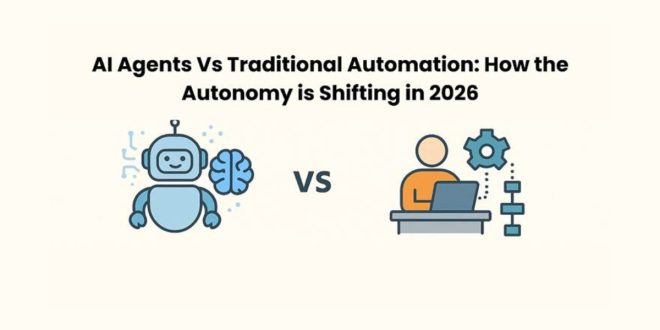
For the last decade, businesses lived by a simple rule: if a task is boring and repetitive, automate it. We built “bots” to move data from one spreadsheet to another, send invoices on the first of the month, and route customer emails based on keywords. Traditional automation worked well, but it was rigid.
Over the past few years, we have witnessed a massive shift away from traditional automation toward AI agents.
The difference isn’t just a technical upgrade; it’s a change in how machines “think” about work. Here is why AI agents have officially taken the crown from traditional automation this year.
Why Traditional Automation Was Great in the Past
Before we entered this new era, traditional automation, often called Robotic Process Automation (RPA), was a miracle for the modern office. It allowed businesses to scale without hiring thousands of people just to do data entry.
In the past, these systems were great because:
- Speed: They could process thousands of forms in seconds.
- Accuracy: Unlike humans, a bot doesn’t get tired or mistype a digit.
- Cost: It was much cheaper to run a script than to pay for manual labor.
- Simplicity: For tasks that never changed, like monthly payroll, a fixed set of rules was all you needed.
How AI Agents Slowly Replaced Them and Where
The shift didn’t happen overnight. It started when we realized that next-gen automation technologies will not just be about speed, but about “understanding.”
Initially, AI was used to help traditional bots “see” better (like reading a blurry invoice). Slowly, these systems evolved into autonomous AI agents. Instead of just following a script, these agents began to take over areas where the rules were fuzzy. This started in customer service chats, then moved to email management, and eventually into complex fields like supply chain logistics. AI agents replacing RPA became the norm because businesses needed systems that could handle changes without breaking.
Why 2026 Is the Tipping Point
If 2024 was the year of “trying” AI, 2026 is the year it became the standard. This is the tipping point for several reasons:
- Reliability: In 2026, agentic AI systems have reached a level of accuracy where they rarely make “hallucination” errors.
- Cost of Compute: The energy and money required to run an agent have dropped significantly.
- Connectivity: Almost every business tool now has a “plug” for an AI agent to connect to.
- Natural Language: We can finally talk to machines in plain English, removing the need for specialized coders to build every single automation.
Where Traditional Automation is Still Good
Despite the hype around AI agents in business automation, traditional automation isn’t dead. It is still the best choice for:
- High-Volume, Low-Complexity Tasks: If you are moving millions of identical data points where the rules never change, a simple script is faster and cheaper.
- Regulated Financial Reporting: When the law requires a process to be done exactly the same way every time for audit purposes, you don’t want an agent “thinking”, you want a fixed rule.
- Simple Triggers: Turning on a light when a sensor is tripped doesn’t need an “agent”; it just needs a switch.
AI Agents Vs Traditional Automation: Business Benefits
In 2026, the most successful businesses don’t replace RPA completely with autonomous AI agents. They use both, but strategically. Here’s why
| Benefit | Traditional Automation | Autonomous AI Agents |
| Consistency | Perfect for 1:1 repetition. | Adapts to the situation. |
| Scalability | Easy to duplicate scripts. | Easy to give new “goals.” |
| Problem Solving | Cannot solve problems. | Finds “Workarounds” on its own. |
| Setup Time | Takes weeks to “map” a process. | Takes minutes to “explain” a goal. |
Using AI agents in business automation allows for a “set and forget” mentality where the agent handles the chaos, while traditional tools handle the foundation.
Examples of AI Agent Autonomy in the Real World
What do AI-driven automation solutions actually look like in 2026?
- The Virtual Travel Agent: Unlike old sites that just showed a list of flights, an agent can now say: “The flight is delayed, so I’ve already moved your dinner reservation back an hour and messaged your Uber driver.”
- The Autonomous Recruiter: An agent can look at 500 resumes, conduct short text-based interviews to clarify skills, and present the manager with the top 3 candidates based on “culture fit,” not just keywords.
- The Supply Chain Manager: If a port is closed due to weather, a supply chain AI agent automatically finds new suppliers, negotiates a temporary price, and updates the shipping trackers without a human ever having to open a laptop.
Challenges of AI Agent Autonomy
Moving toward autonomous AI agents is not smooth:
- The “Black Box” Problem: Sometimes it’s hard to tell why an agent made a specific decision.
- Security: If an agent has the power to spend company money, it needs incredibly tight guardrails to prevent fraud or mistakes.
- Over-Reliance: If the AI makes 99% of the decisions, humans might lose the “muscle memory” of how to do the job themselves when the power goes out.
Which is Less Expensive: AI Agent Vs Traditional Automation
While AI agent development might seem more expensive initially because it requires more computing power, the long-term math has changed. Traditional automation required a massive “hidden cost” of human oversight and constant re-coding.
AI agents reduce the “cost per decision.” Because they handle the exceptions and the messy data that used to require a $30/hour human, the business saves more in the long run. We are moving from a world where we pay for “clicks” to a world where we pay for “outcomes.”
Are AI Agents Replacing Humans?
So, if agentic AI systems are replacing automation, are they replacing us?
The answer is a clear NO, but our jobs have changed. We have moved from being “operators“ (the people who push the buttons) to “architects“ (the people who set the goals).
Humans are no longer spending days doing data entry; they are spending days deciding which data matters. Real customer support agents aren’t answering the same customer question 50 times a day; they are teaching agents to represent the brand’s voice more empathetically.
What’s Ahead
The future of automation in 2026 and beyond is moving toward “Agent Ecosystems.” Soon, your business’s AI agent will talk directly to your supplier’s AI agent. They will negotiate prices, sign contracts, and manage deliveries without any humans involved. We are moving toward a world where humans provide the vision and agents execute.
Conclusion
Traditional automation was great when businesses needed to automate only repetitive operations. It gave us speed and consistency. But in the fast-moving, data-heavy world, consistency isn’t enough. We need adaptability.
The transition from intelligent automation to traditional automation marks a shift in how we see computers. They are no longer just machines; they are teammates. By embracing AI agents in business automation, we aren’t just making things faster; we are making them smarter.
FAQs
What is the main difference between an AI agent and traditional automation?
Traditional automation follows fixed, predefined steps and fails when conditions change. AI agents focus on achieving outcomes. They interpret context, decide actions, and adapt in real time. Instead of executing instructions, they figure out how to complete a task, making them more flexible and useful in dynamic, unpredictable business environments.
Is traditional automation officially dead in 2026?
Not at all. In fact, it’s still the “gold standard” for tasks that require 100% predictability. For example, if you are processing payroll or filing tax documents, you don’t want a machine “reasoning” or getting creative; you want it to follow the law exactly. Traditional automation is also faster and cheaper for high-volume, static tasks. In 2026, most smart businesses use a “hybrid” model using traditional scripts for the high-volume manual workflows and AI agents for the messy, unpredictable parts.
Do AI agents require a lot of coding to set up?
One of the biggest advancements is that you can “train” an AI agent using natural language. Instead of writing complex code, a manager can simply type out a set of guidelines and goals. While developers are still needed to connect the agent to secure company databases, the day-to-day “logic” of the agent is often handled by regular employees who just know how to explain their job clearly.
Can I trust an AI agent to make financial decisions?
While agents are smart, they can still make mistakes or “hallucinate” logic. This is why “Human-in-the-loop” systems are standard now. Most businesses set spending limits or boundaries for agents. For instance, an agent might be allowed to refund a customer up to $50 autonomously, but any amount above that requires approval from a human supervisor.